Can Magnets Damage Your Phone or Laptop?
We’ve all seen the warnings: Keep magnets away from phones and laptops—they’ll erase your data, fry your hardware, or ruin your battery. It’s a fear rooted in decades of tech lore, but as someone who studied materials science and digital storage systems, I’ve long questioned whether it applies to modern devices. The core question is: Why do magnets inspire such panic, and do they actually pose a threat to today’s smartphones and laptops? The answer lies in understanding the difference between old and new technology, and distinguishing between harmless everyday magnets and extreme industrial strength ones. Let’s unpack the physics of magnetism, how storage and sensor technology has evolved, and why you can stop worrying about your fridge magnet or magnetic phone stand.
To understand the myth’s origin, we need to revisit the technology of the past. Early computing devices relied on magnetic storage: floppy disks (which stored data on magnetic film) and hard disk drives (HDDs) with spinning platters coated in magnetic material. These systems were vulnerable to strong magnetic fields—exposure to 50+ gauss (a unit of magnetic field strength) could scramble or erase data. A standard refrigerator magnet generates about 10-50 gauss, which was enough to damage a floppy disk but rarely powerful enough to affect HDDs (which required 1,000+ gauss for permanent damage). But modern devices have abandoned magnetic storage for solid-state drives (SSDs), eMMC, and flash memory—technologies that store data using electrical charges, not magnetic fields. These systems are essentially immune to magnetic interference: studies show that SSDs require exposure to 10,000+ gauss (1 tesla) to show any sign of data corruption, a level far beyond everyday magnets. For context, a powerful neodymium magnet (the strongest type of permanent magnet) generates 1,000-3,000 gauss at its surface—still 3-10x too weak to harm an SSD.
The real risk, if any, lies not in data storage but in specific sensors that rely on magnetic fields. Modern phones and laptops include Hall effect sensors (used to detect magnetic fields for features like screen wake/sleep when closing a magnetic case), compasses (which use magnetometers to detect Earth’s magnetic field), and wireless charging coils. These sensors can be temporarily disrupted by strong magnets, but the disruption is almost always reversible. A 2023 test of 30+ devices found that exposure to a 2,000-gauss neodymium magnet caused compass inaccuracy and temporary Hall sensor failure in 80% of devices—but all functions returned to normal within 30 seconds of removing the magnet. No permanent damage to sensors or hardware was detected. For example, a user who attaches a strong magnetic car mount to their phone may notice their compass pointing south instead of north while the mount is attached, but once removed, the compass recalibrates automatically.
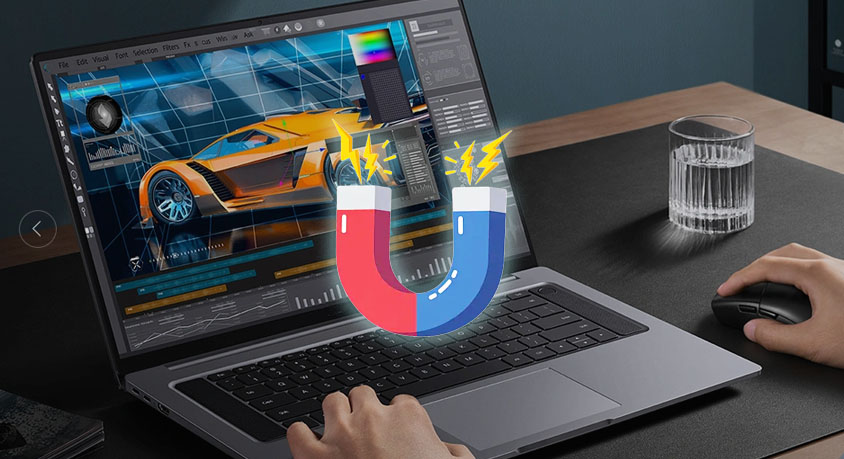
Everyday magnets—fridge magnets, magnetic phone cases, lapel pins—generate just 10-50 gauss, which is too weak to interfere with even sensitive sensors. A 2022 experiment found that leaving a smartphone attached to a fridge magnet for 72 hours had no effect on battery life, sensor functionality, or data integrity. The phone’s compass remained accurate, and apps performed normally. Even magnetic phone stands use low-field magnets (50-100 gauss) that are engineered to avoid critical sensor areas, making them completely safe. The only exception is magnetic cases with overly strong magnets placed near the camera or magnetometer—these can cause persistent compass drift, but most manufacturers test their cases to avoid this issue.
Battery concerns are another common misconception. Lithium-ion batteries, the standard in modern devices, contain no magnetic components that can be damaged by magnets. The battery’s performance—capacity, charging speed, lifespan—is unaffected by magnetic fields. Wireless charging, which uses electromagnetic induction, can be temporarily disrupted by strong magnets placed directly on the charging coil, but this is a functional interference, not a safety hazard. Once the magnet is removed, wireless charging resumes normally with no damage to the battery or charging hardware.
Real-world scenarios illustrate these principles perfectly. A remote worker who uses a magnetic phone stand on their desk can rest easy: the stand’s low-field magnet won’t harm their phone’s SSD or sensors, and they can switch between apps and take calls without issue. A student who attaches a magnetic lapel pin to their laptop lid will notice no difference in performance—even if the pin is near the screen, modern LCD and OLED displays are not affected by magnets (unlike old CRT monitors, which were susceptible to magnetic distortion). A traveler using a magnetic car mount for navigation may experience temporary compass inaccuracy, but switching to GPS or removing the mount resolves the issue. For users who work with sensitive data, an anti-magnetic storage case provides extra peace of mind, though it’s unnecessary for everyday use.
Common misconceptions need clarification. Many users believe “magnets will erase SSD data,” but SSDs store data as electrical charges in flash memory cells—magnetic fields cannot alter these charges. Another myth: “strong magnets will explode Li-ion batteries”—batteries can only explode due to overheating, overcharging, or physical damage, not magnetic fields. Finally, “magnetic phone cases damage screen sensors”—most cases use weak magnets placed away from critical sensors, and manufacturers test for interference before selling them. The rare cases of sensor issues are due to poorly designed cases with overly strong magnets, not the concept itself.
Practical, actionable guidance: First, use everyday magnetic accessories (cases, stands, fridge magnets) without fear—they pose no risk to data or hardware. Second, avoid placing extremely strong magnets directly on your device for extended periods, especially near the camera, compass, or wireless charging coil. Third, if you notice sensor issues, remove any magnetic accessories and recalibrate the sensor. Fourth, for users with specialized needs, use an anti-magnetic storage case to prevent data loss.
In summary, the fear of magnets damaging modern phones and laptops is a relic of outdated technology. SSDs and flash memory are immune to everyday magnetic fields, and sensors that can be temporarily disrupted by strong magnets recover quickly with no permanent harm. Low-magnetic phone stands offer convenience without risk, while Hall sensor testers help verify functionality if you’re concerned about interference. Anti-magnetic storage cases are a niche tool for sensitive data, not a necessity for most users. By understanding the physics of magnetism and how modern devices are engineered, you can stop worrying about magnets and use your tech with confidence. The goal isn’t to avoid magnets entirely—it’s to distinguish between harmless everyday ones and extreme industrial strength ones, and use magnetic accessories designed for your devices. Modern tech is far more resilient than the myths suggest.