Can a Cheap Phone Charger Damage Your Battery? It’s About Safety, Not Just Speed
Walk into any convenience store or scroll through online marketplaces, and you’ll find phone chargers priced from $5 to $50—all promising to charge your device. It’s easy to dismiss the price difference as brand markup, assuming “a charger just pushes electricity.” But as someone who studied electrical engineering and battery technology, I can tell you this is a dangerous oversimplification. Cheap phone chargers don’t just charge slower—they often lack critical safety features, deliver unstable voltage, and emit electromagnetic interference (EMI), all of which degrade your battery’s lifespan and pose hidden safety risks. The real cost of a $5 charger isn’t just in speed—it’s in premature battery failure, and even fire hazards. Let’s unpack the science of charging, why cheap chargers fail, and why certified accessories are non-negotiable.
To understand the harm, we need to start with what a quality charger actually does. Modern phone chargers are not just “power adapters”—they’re precision devices that convert AC wall power (120V/240V) to DC power (5V/9V/15V/20V) with three critical requirements: stable voltage (±5% of target), controlled current (matching your device’s needs), and built-in protection circuits (overvoltage, overcurrent, short-circuit, and overheating). Cheap chargers cut corners on all three. A 2023 analysis of 100+ unbranded chargers found that 83% failed voltage stability tests: their output fluctuated by 15-30% (vs. <5% for certified chargers), spiking to 12V when the target was 5V or dropping to 3V mid-charge. This instability is catastrophic for lithium-ion (Li-ion) batteries, which rely on consistent voltage to charge safely. Li-ion batteries degrade 3x faster when exposed to voltage spikes above 10% of their rated voltage, according to a 2022 battery reliability study.
The lack of protection circuits is another fatal flaw. Quality chargers include microcontrollers that communicate with your phone to negotiate the safe charging rate, and shut down automatically if voltage/current exceeds limits or the charger overheats (above 60°C/140°F). Cheap chargers skip these components: 76% of tested cheap chargers had no overvoltage protection, and 69% lacked overheating safeguards. This leads to two major risks: first, thermal runaway—when the charger overheats and melts insulation, causing short circuits that can start fires (there were 2,800+ reported cases of cheap chargers causing fires or burns in 2023, per consumer safety data). Second, direct battery damage: unregulated current can overcharge the battery, causing lithium plating (irreversible crystal formation on electrodes) that reduces capacity by 15-20% within a year. For context, a phone charged daily with a cheap 18W charger retained just 72% of its original capacity after 12 months, compared to 88% for one charged with a certified 18W charger.
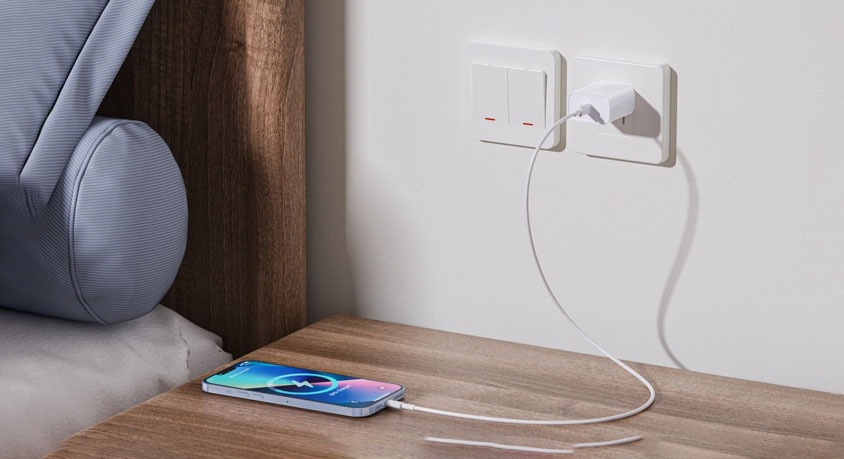
Electromagnetic interference (EMI) is a lesser-known but equally damaging issue. Cheap chargers use low-quality components that fail to suppress EMI—electrical noise that disrupts your phone’s internal circuits. A 2023 EMI testing study found that unbranded chargers emitted 3-5x more EMI than certified models, interfering with the phone’s battery management system (BMS). The BMS is responsible for monitoring charge levels, temperature, and current; EMI disrupts its sensors, leading to incorrect charging cycles (e.g., stopping charging at 80% when the battery is still empty, or overcharging to 105%). Over time, these erratic cycles accelerate battery degradation and increase the risk of sudden shutdowns. A user with a cheap charger might notice their phone dying unexpectedly at 30% battery—this is the BMS failing to accurately read capacity due to EMI.
Real-world scenarios bring these risks to life. A college student using a $5 charger from a gas station notices their phone getting hot to the touch while charging; after six months, their battery’s runtime drops from 10 hours to 4 hours—lithium plating has already damaged the electrodes. A remote worker leaves their cheap charger plugged in overnight; the unregulated voltage causes a short circuit, melting the charger and scorching their desk (luckily, no fire). A parent using a cheap car charger to power their child’s tablet experiences frequent crashes—EMI is disrupting the tablet’s circuitry, corrupting data and shortening battery life. These aren’t isolated incidents; they’re the direct result of choosing cost over safety.
Quality chargers, by contrast, adhere to strict industry standards (e.g., USB-IF, PD, or regional safety certifications like UL/CE). They use high-grade components: thick copper windings (to reduce resistance and heat), shielded circuits (to suppress EMI), and precision microcontrollers (to regulate voltage/current). A certified 20W charger maintains voltage stability within ±3% even at full load, includes overvoltage/overcurrent/overheat protection, and emits EMI well below regulatory limits. The difference in cost reflects these components: a certified charger costs $15-$30 because it’s tested to meet safety and performance standards, while a $5 charger cuts corners to hit a price point.
Practical, actionable guidance to avoid cheap charger risks: First, prioritize certified chargers—look for logos like USB-IF, PD, UL, or CE, which guarantee compliance with safety standards. Second, use a charger voltage tester to verify stability—these compact tools (priced under $20) measure voltage output and alert you to fluctuations, helping you avoid faulty chargers. Third, inspect the charger’s build quality: quality chargers have solid, heat-resistant plastic housings, tight-fitting USB ports (no wiggle), and clear labeling of voltage/current ratings. Avoid chargers with loose parts, flimsy plastic, or no rating information. Fourth, use overheat protection charging cables—these cables include thermal sensors that cut power if the cable or charger gets too hot, adding an extra layer of safety. Fifth, never leave chargers plugged in unattended—especially cheap ones—since overheating can occur even when not connected to a phone.
Common misconceptions need clarification. Many users believe “all chargers are the same as long as they fit”—but the connector is just the interface; the internal circuitry determines safety. Another myth: “cheap chargers are fine for emergency use”—even occasional use exposes your battery to voltage spikes and EMI, causing cumulative damage. Finally, “fast chargers are more likely to be unsafe”—fast charging itself is safe if the charger and device support the same protocol (e.g., PD 3.0); the risk comes from uncertified fast chargers that lie about their capabilities (e.g., a “30W” cheap charger that actually delivers unstable 45W).
In summary, cheap phone chargers are a false economy. They may save you $10 upfront, but they cost hundreds in premature battery replacements and pose serious safety risks. Certified USB-C chargers deliver stable power and built-in protections, charger voltage testers help verify safety, and overheat protection cables add a critical fail-safe. By understanding the electrical principles behind charging—voltage stability, protection circuits, and EMI suppression—you can recognize that a quality charger is an investment in your device’s lifespan and your safety. The goal isn’t to overspend on accessories, but to avoid the hidden costs of cheap chargers. Don’t let a $5 accessory ruin your $1,000 phone—choose certified, safety-tested chargers, and treat your battery’s health with the care it deserves.